
Molecular cloning design
7 Molecular Cloning Design Mistakes to Check Before Going to the Bench
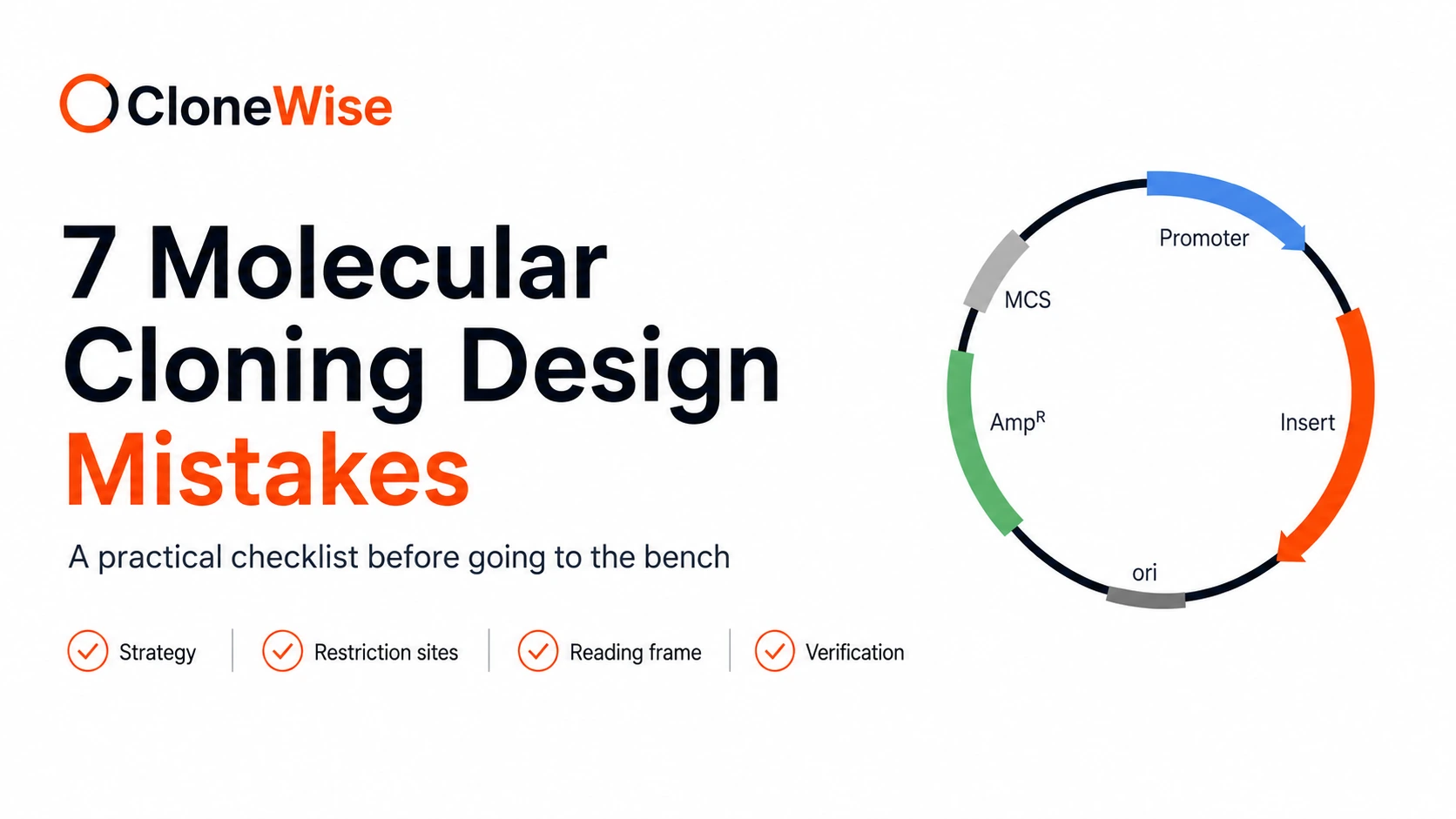
Many molecular cloning problems begin long before the experiment starts. In several cases, the cloning method itself is not the main issue. The real problem is often an unclear strategy, unsuitable vector choice, missed restriction sites, incorrect reading frame, or incomplete construct planning.
A careful in silico review of the cloning design can help researchers identify these issues before ordering primers, synthetic DNA, or starting bench work. These checks are especially useful for researchers designing Golden Gate, Gibson, restriction cloning, CRISPR, and plant expression constructs.
1. Choosing the cloning method before defining the final construct
One common mistake is selecting a cloning method too early. Golden Gate cloning may be ideal for modular or multi-fragment assembly, while Gibson assembly may be more suitable for seamless joining of selected DNA fragments. Restriction enzyme-based cloning can still be useful for simple insert-vector cloning, but it requires careful compatibility checks.
Before choosing the method, it helps to know what you are actually building: how many DNA fragments are involved, which vector backbone and insert size you are working with, the orientation the insert needs, any scar sequences you can or cannot tolerate, the downstream expression system, and how you intend to screen and sequence the result.
A clear cloning strategy should come before primer design.
2. Missing internal restriction sites
For restriction enzyme cloning and Golden Gate cloning, internal restriction sites are critical. If the insert contains internal BpiI, BsaI, or other relevant recognition sites, the DNA fragment may be cut unexpectedly during digestion. This is just as relevant for CRISPR work, where guide-RNA and editing constructs are often assembled by Golden Gate using these same Type IIS enzymes.
The consequences are familiar: failed assemblies, unexpected gel bands, wrong colonies, or confusing sequencing results. Before finalizing a plan, it is worth checking for internal BpiI or BsaI sites, confirming vector-specific restriction sites, deciding whether silent mutations are needed to remove a problematic site, and considering whether an alternative cloning method would simply be cleaner.
3. Not confirming the reading frame
Reading-frame errors are common in fusion constructs. This matters most when designing constructs with fluorescent proteins, epitope tags, localization signals, linkers, or protein domains.
A construct may look correct at the DNA level but still produce an incorrect protein if the reading frame is shifted. For expression constructs, the final in silico sequence should always be translated and reviewed before experimental work begins.
4. Overlooking the promoter–gene–terminator logic
A plasmid is not only an insert and a vector. The complete expression cassette must be logically correct.
For plant expression constructs, check the promoter, coding sequence, tag, localization signal, terminator, selectable marker, and vector backbone as a connected whole. Common issues include a wrong promoter for the intended expression system, a missing terminator, an incorrect tag position, an unwanted stop codon before a C-terminal tag, a missing nuclear localization signal, or confusion between transient and stable expression vectors.
5. Treating primer design as a separate step
Primer design is often done quickly, but small errors here create major cloning problems. Cloning primers should not only amplify the correct fragment; they should also support the chosen assembly method and the final construct design.
Before ordering primers, confirm:
- The annealing region and melting temperature
- Any added overhangs, restriction sites, or Golden Gate overhangs
- Start and stop codon logic, and the reading frame
- Extra bases required for efficient restriction digestion
- Fragment orientation
6. Not planning construct verification
A cloning strategy is incomplete without a clear plan to confirm the final construct. Even when colonies grow, they may carry the wrong insert, an incorrect orientation, a partial assembly, or unintended mutations.
Plan the verification before you start the experiment:
- Colony PCR primers and expected band sizes
- Restriction digest confirmation
- Sequencing primers, with attention to junction regions
- Full insert sequencing where it is required
7. Not reviewing the final plasmid map
Before ordering primers or synthetic DNA, review the complete plasmid map carefully. This includes the backbone, insert, promoter, tags, terminator, selectable marker, origin of replication, and all relevant restriction sites.
A good final review confirms that the insert is in the correct orientation, the reading frame is correct, all functional elements are present, unwanted restriction sites are absent, the primers are compatible with the cloning method, and the construct can be verified by PCR, restriction digest, or sequencing.
Conclusion
Successful cloning starts with a clear design. Many cloning failures can be avoided by checking the strategy, vector compatibility, restriction sites, reading frame, primer logic, construct verification plan, and final plasmid map before starting experimental work.
In silico cloning review is not just a technical step. It is an important part of experimental planning.
Need help reviewing your cloning design?
At CloneWise, we support researchers with cloning strategy selection, plasmid and construct design, and in silico review of cloning plans before experimental work begins.
Contact: contact@clonewise.de
Start a project